
Pool Filter Repair in Frisco, TX
We Open the Tank First
We find which part failed, whether that is a grid, a manifold, a lateral, an O-ring or a valve, and we repair that part.
Response Time 1 to 2 Hours
What a Failing Filter
Costs You
Licensed technicians who open the tank before quoting a single part
Your filter catches everything the water picks up before it reaches the pump. It runs every day through a Frisco summer, and when it finally fails the fault is usually small and specific. A grid splits along a seam, or a manifold cracks around a port, or an O-ring flattens after six seasons of heat.
The water shows it first. Pressure climbs eight to ten psi above the clean starting reading, which is the point at which the filter needs servicing. Or the pool stays cloudy after a full clean. Or DE powder settles on the plaster within hours of a backwash. Those three symptoms have three different causes, so the fix depends on which part gave out.
Most filter repairs go wrong right here. Cleaning a filter with a torn grid accomplishes nothing, because the tear is still there when the tank goes back together. Replacing a whole system over a $40 O-ring costs a homeowner thousands. Our technicians hold a Residential Appliance Installer License issued by the Texas Department of Licensing and Regulation, and they open the tank and pressure test the system before anyone quotes you a part.
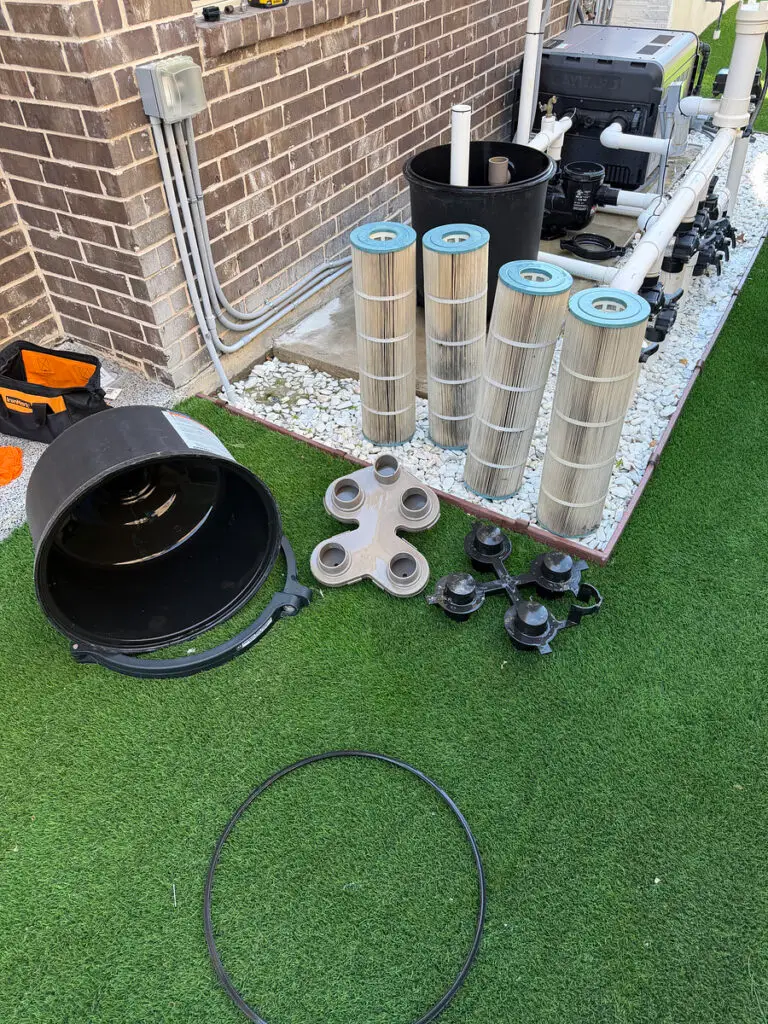
Pressure Test + Full Teardown + Component Diagnosis
+ Part Replacement + System Verification
Every filter repair follows the same sequence, because guessing at a filter costs more than diagnosing one. We work through the system in order and write down what we find. You get a written quote before anything gets replaced.
Pressure and Flow Test
We record operating pressure against the clean starting reading and check return flow to confirm whether the restriction is the filter or somewhere else in the circulation loop.
Full Tank Teardown
The tank comes apart completely. We pull the grids or cartridges, lift the manifold off the standpipe, and expose every internal surface for inspection.
Component Diagnosis
We check every grid for tears and separated seams. Then we inspect the manifold for chips and hairline cracks, the joints, the air bleed sock, and the tank body.
Part Replacement
We replace only the failed components, using OEM parts. Grids, manifolds, O-rings, laterals, gauges and valve gaskets all swap out without touching the tank.
Reassembly and Verification
We reassemble the system, prime it, and run it under pressure. Then we confirm the new baseline reading and check the returns for carryover before leaving your property.
Pool Filter Repair in Frisco, TX
Nobody thinks about a pool filter until the water goes cloudy, the pressure gauge climbs, or the returns start pushing powder instead of water. NorTex Pools handles pool filter repair for Frisco homeowners on all three filter types, cartridge, sand and DE, and we service every major brand including Pentair, Hayward and Jandy. All three build to the residential pool standards published by the Pool & Hot Tub Alliance. Every job begins with a diagnosis.
How to Tell a Broken Filter From a Dirty One
A dirty filter and a broken filter look similar for about a week. The difference shows up in how the system behaves afterwards. If pressure returns to its clean reading and holds there, the filter was simply dirty. If it climbs again within days, something mechanical has failed.
- Pressure sits eight to ten psi above the clean starting reading
- Return jets have noticeably weaker flow
- The pool stays cloudy after a full clean and balanced chemistry
- Water pools around the tank band, lid or valve
- DE powder or sand appears on the pool floor
- Filter cycles are getting shorter and shorter
- The multiport valve is stiff or leaks from the handle
- The pump runs louder or hotter than normal
One symptom alone rarely identifies the fault. Weak flow with high pressure points to a clogged or collapsed element. Weak flow with low pressure points somewhere upstream on the suction side, which means the filter may be fine. A pool filter repair that starts by reading both gauges together tends to end with the right part being replaced.
DE Filter Blowback: Why Powder Returns to Your Pool
DE blowback is the most common DE filter complaint we see in Frisco, and it is almost always mechanical. Diatomaceous earth slips through openings you cannot see with the tank open in front of you. A hole the size of a pen tip will pass powder, though a pin tip is generally too small to matter. So when DE reappears in the pool after you charge the filter, something inside that tank has opened a path.
Where the powder shows up narrows the cause considerably, and it costs nothing to check.
| Where the powder appears | What it usually means |
|---|---|
| Steadily, from the return jets | Torn grids, a cracked manifold, or a failed standpipe O-ring |
| A burst for 20 to 30 seconds at every startup | The manifold is not seating, or the standpipe O-ring has gone |
| Only when you add fresh DE | The multiport valve gasket is bypassing |
| From the skimmers, or clouding the main drain | The filter is back-draining through the pump |
| A gradual haze with no visible plume | Pinhole tears spread across several grids |
Those symptoms trace back to a short list of parts, and the repair costs are nowhere near comparable.
- Torn or split grids, by far the most frequent cause. Fabric thins at the seams, stitching unravels, or the plastic core breaks down and punctures the cloth from inside.
- A cracked or chipped manifold. Damage opens around the ports and at the joints, usually from running at high pressure, from a closed return valve producing water hammer, or from the grid assembly tipping over while it sits out of the tank.
- A missing or flattened standpipe O-ring, which is what seals the manifold to the standpipe. Once it fails, DE bypasses the grids completely.
- A damaged air bleed sock. That small screen on top of the manifold strains the air relief, and once it tears or seats badly, powder has a direct route to the returns.
- Loose or unevenly seated grids. If the thru-bolt is not fully tightened, DE escapes through the gap where each grid meets the manifold.
- A worn multiport valve gasket, which lets water cross between ports. Moving the valve handle before shutting the pump off is what usually destroys it.
- Back-draining through the pump. A suction-side air leak drains the filter backward when the pump shuts down, pushing DE out through the skimmers and main drain. A check valve solves it.
- Too little water flow. Water flow is what holds the DE cake against the grids, so when flow drops far enough the cake falls off and the powder ends up on the pool floor.
- Flow above the filter’s rated media rate. Every filter has a maximum flow its surface area can handle, and past that point the pump drives DE and debris into the fabric weave instead of through it.
Homeowners get the dose wrong in both directions, and there is a published figure for it. The accepted precoat rate runs from one to one and a half pounds of DE for every 10 square feet of filter area, and 1.25 pounds per 10 square feet, or roughly 2 ounces per square foot, is the commonly accepted value. Dosed properly, the powder forms a cake on the grids somewhere between one sixteenth and one eighth of an inch thick. Too little and the grids never coat, which shows up as cloudy water and unusually short filter cycles. Too much and the excess has nowhere to go but back into the pool. One more thing that catches people out: a one-pound coffee can holds nothing like a pound of DE, and that substitution alone clouds a lot of Frisco pools every summer.
Every one of these needs the tank open to confirm. Replacing a full grid set when the real fault is an O-ring is an expensive mistake. So is buying new grids every season when flow above the filter’s rating is quietly shredding them. We pull the assembly, inspect each grid individually, check the manifold and its joints under light, examine the air bleed sock, test the valve, and confirm the pump is matched to the filter before we quote a single part. That sequence is standard on every DE pool filter repair we run.
- Torn or split grid replacement
- Cracked and chipped manifold repair
- Standpipe O-ring replacement
- Air bleed sock and air relief rebuild
- Multiport valve gasket service
Cartridge Filter Repair
Cartridge filters have fewer moving parts than DE systems, so cartridge pool filter repair concentrates on the element and the seals. Clean a cartridge enough times and it eventually loses pleat structure. The pleats collapse against each other. Surface area drops, and pressure climbs no matter how thoroughly you rinse it.
Leaks are the other common call. Water at the tank band usually means a failed band clamp or a lid O-ring that has hardened and lost its seal. Both are inexpensive repairs. A crack in the tank body itself is a different conversation entirely.
- Split or collapsed cartridge replacement
- Tank band and clamp repair
- Lid O-ring and seal replacement
- Pressure gauge replacement
- Tank body crack assessment
Sand Filter Repair
Sand in the pool after the system runs means the media is bypassing the filter, and a broken under-drain lateral is the usual culprit. A cracked or unseated standpipe does the same thing higher up. Both are repairable without replacing the tank. Check the pressure history at the same time, because sustained high filter pressure is itself a common cause of lateral damage. A broken lateral is often the symptom of a second problem upstream.
Sand also stops working. Grains lose their edges, mineral deposits block the bed, and water begins channeling straight through instead of filtering. Where the blockage sits in the top layer, replacing the top inch or two of sand often restores it. Where the whole bed has gone, a full media change fixes it without touching the tank or valve, and it is one of the least expensive pool filter repair jobs we quote.
High Filter Pressure
Rising pressure is the most common reason Frisco homeowners search for pool filter repairs, and it is the symptom most often treated without being diagnosed. A dirty element restricts flow and raises pressure, which is why cleaning appears to fix it. When the reading climbs back within a week, the restriction was never the dirt.
Persistent high pressure usually traces to filter fabric plugged with oils, dirt and minerals, dirty DE settled in the bottom of the tank, channeled sand, a collapsed cartridge, or a valve stuck between positions. The cause most people never check is pool chemicals being fed into the circulation line ahead of the filter, where they attack the media directly. Frisco’s hard water accelerates all of it. Left alone, the pump works against the restriction and the motor fails long before the filter does.
Pool Filter Leaks
Where the water appears tells you what failed, and it decides how involved the pool filter repair becomes. A drip from the tank band points to the clamp or the body O-ring. Water at the multiport valve usually means the valve gasket or the stem seal. A weeping pressure gauge port is often just a loose fitting and thread tape.
None of these are expensive on their own. Ignored through a Frisco summer, however, a slow leak washes out the equipment pad, undermines the slab, and corrodes the fittings around it. That is when a $30 seal becomes a much larger bill.
When Cleaning Will Not Fix It
Cleaning gets rid of what the filter has collected. Repair deals with a part that has broken. No amount of cleaning corrects a torn grid, a cracked lateral or a failed seal, so the two jobs solve different problems. This matters for more than water clarity, since the CDC treats working filtration and circulation as the foundation of safe swimming.
There is a commercial angle too. If you have cleaned the filter three times this season and pressure still climbs, you are paying for maintenance to solve a mechanical problem. An inspection costs less than the fourth cleaning.
Why Frisco Pools Are Hard on Filters
North Texas water is hard, and calcium is unforgiving on filter media. It bonds to DE grids and cartridge pleats, resists ordinary rinsing, and steadily reduces the surface area doing the filtering. Mineral buildup is also the one form of fouling a normal rinse will not touch, which is why scaled media needs an acid treatment rather than another wash.
The season is long, too. Frisco pools run heavy loads from April through October, and summer heat degrades rubber components faster than most homeowners expect. O-rings, gaskets and lid seals are consumables here, not permanent parts. Because we work in one city, our technicians know exactly which failures this water produces, and which pool filter repair each one calls for.
FREQUENTLY ASKED QUESTIONS
How much does it cost to repair a pool filter?
Most pool filter repairs cost far less than homeowners expect, because the failure is almost always a single component rather than the filter itself. NorTex Pools charges a flat $150 service call in Frisco covering arrival, full equipment inspection and a written diagnosis, and applies that fee toward the repair if you proceed. Weekly maintenance plan members pay $135. Parts account for the rest. An O-ring or a pressure gauge sits at the bottom of the range, and a full DE grid set typically runs $150 to $400 in parts depending on filter size.
How long do DE filter grids actually last?
Manufacturers rate DE filter grids for three to five years, but well-maintained grids routinely last five to ten. The difference is how the fabric is cleaned. Grids fail from clogged fabric and wear rather than age, and the correct sequence matters: a commercial filter cleaner lifts oils and grease first, and an acid treatment follows only if minerals remain. Skipping to acid every time shortens grid life rather than extending it. Frisco's hard water makes mineral buildup the deciding factor, which is why we inspect grids individually instead of replacing a set on a schedule.
Can a cracked or leaking pool filter be patched?
A cracked filter tank cannot be reliably patched, because it is a pressure vessel and epoxy or sealant fails under operating pressure. Most leaks are not tank cracks, though. Water at the tank band usually means the clamp or the body O-ring. At the valve it means the valve gasket. At the gauge it is often just a loose fitting. All of those are routine pool filter repair parts. If your filter is leaking right now, shut the pump off and leave it off until it is diagnosed. Pressure filters can separate violently if a clamp or fitting is disturbed while the system is under pressure, which is why the pump goes off and the air relief valve gets opened before anyone touches the tank.
Why is my pool filter blowing DE powder or sand back into the pool?
Filter media returning to the pool means it is bypassing an internal part, and where it appears identifies which one. From the return jets points to torn DE grids, a cracked manifold, or a failed standpipe O-ring. From the skimmers or clouding the main drain means the filter is back-draining through the pump. Only when you add fresh DE points to the multiport valve gasket. Sand in the pool almost always means a broken under-drain lateral or standpipe. DE passes through a hole the size of a pen tip, so a proper pool filter repair starts with the tank coming apart to confirm the cause.
Why does my pool filter pressure keep climbing after I clean it?
Pressure that returns to high within days of a cleaning means the restriction was never dirt. A genuinely dirty filter drops to its clean reading and holds there for weeks. When it climbs back quickly, the usual causes are filter fabric plugged with oils and minerals, a collapsed cartridge, channeled sand, a valve stuck between positions, or chemicals being fed into the circulation line ahead of the filter. Frisco's hard water accelerates all of them. Continuing to clean it forces the pump to work against the restriction, and the motor fails long before the filter does.