
Cartridge, sand and DE filters matched to your flow rate and plumbing, then installed and pressure tested.
Response Time 1 to 2 Hours
Filter capacity is measured in square feet of media area, and every filter carries a maximum flow its area can handle. Exceed it and the filter stops doing its job. Water forces dirt deep into the media instead of catching it at the surface, and on sand it carves channels straight through the bed.
The number that governs this comes from your pump, so a pool filter installation is really a pump question wearing a filter label. Undersize the filter against the pump and you get short cycles, constant cleaning and cloudy water. Oversize it and nothing bad happens except the bill.
We measure the flow the system actually delivers before recommending anything. Our technicians hold a Residential Appliance Installer License issued by the Texas Department of Licensing and Regulation, and every install ends with the tank pressure tested rather than simply switched on.
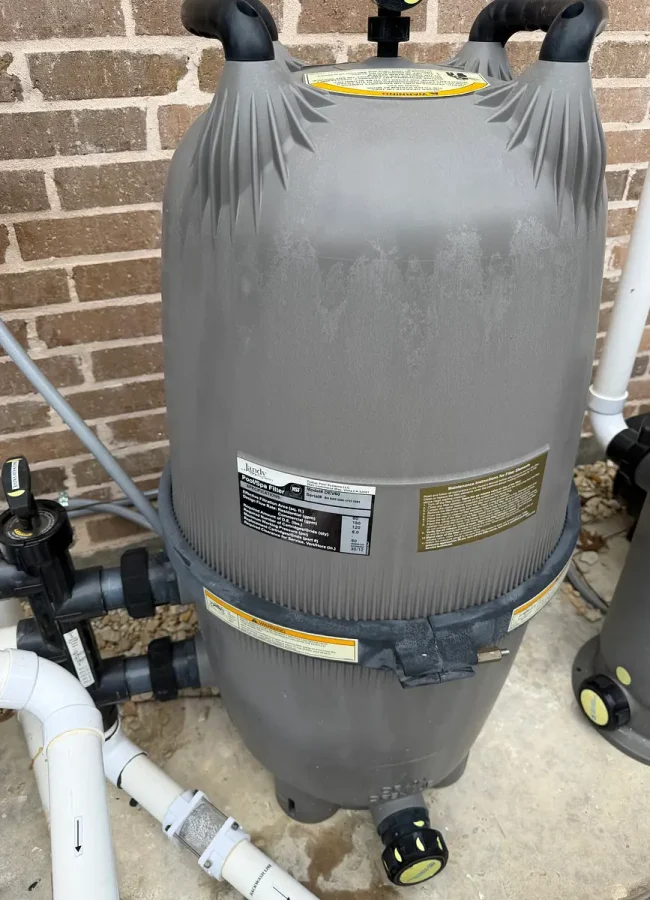
Choosing a filter takes one measurement and one decision. The measurement is your flow rate. The decision is which media suits how you want to look after the pool.
We establish what your pump actually delivers, since that number sets the minimum filter area and rules out anything undersized.
Cartridge, sand or DE, chosen around the clarity you want and the maintenance you are willing to do rather than around what fits the pad.
We size the filter area comfortably above the flow requirement, which lengthens the run between cleans and lowers the pressure the pump works against.
We set the tank level, plumb it with unions either side, and position the valve so you can operate and service it without dismantling anything.
We run the system, record the clean starting pressure, check every joint under load, and write that baseline down for you.
Filtration is the part of a pool nobody thinks about. Then the water goes cloudy and chemistry will not fix it. NorTex Pools handles pool filter installation across Frisco on cartridge, sand and DE systems. We work with Pentair, Hayward and Jandy, and Pentair filters are the most searched of the three by a clear margin. All build to the residential standards published by the Pool & Hot Tub Alliance.
Three media types dominate residential pools. They filter to genuinely different levels, and that difference decides how clear your water looks before chemistry does anything.
Water clarity follows that order, and so does maintenance effort. Choose on which of those two you care about more, because a filter matched to your habits gets looked after and one that fights them does not.
Filters carry a rating in square feet of media area, and that rating comes with a maximum flow. Your pump decides which filters even qualify. Sizing therefore runs from the pump outward rather than from the pool inward.
Exceeding the rated flow does specific damage. Dirt gets driven into the media instead of trapped on its surface, which makes cleaning less effective every cycle. Sand beds channel, and once water finds a path through the bed it stops filtering and simply passes through.
Going larger costs money and nothing else. A generously sized filter runs longer between cleanings, holds a lower operating pressure, and gives the pump an easier time. When budget allows, size up.
Treat pump and filter as one system. A pump that delivers more flow than the filter can take pushes water past the media rather than through it. A pump that delivers too little never completes enough turnovers, and the pool stays faintly cloudy whatever you add to it.
Variable speed pumps change this conversation usefully. You can dial the flow down, so a filter that looks marginal at full speed sits comfortably at the speed the pool runs most of the day.
If you are replacing both, do them together. A pool filter installation planned alongside a new pump lets us match the pair properly instead of fitting one around the limitations of the other.
Cartridge systems are the most common choice in new Frisco installations. The reason is the missing backwash line. No water goes to waste, and there is no valve to operate.
The element is what you maintain. It lifts out, you rinse it, it goes back. Over time the pleats lose structure and the element stops recovering pressure after a clean. At that point it needs replacing rather than another rinse.
Larger cartridge filters buy real convenience. A generously sized unit stretches the interval between cleanings considerably, and on a multi element filter the work is the same regardless of the tank size.
Sand is the simplest system to live with. Filtration happens through the bed. Backwashing reverses the flow and sends accumulated dirt to waste. The media lasts years before it needs changing, and there is no element to buy.
DE sits at the other end. Powder coats a set of grids and filters far finer than either alternative, which is why DE pools look the way they do. The trade is the media. You recharge it after every clean.
Both need a waste line and somewhere legal for that water to go, which occasionally decides the question before anything else does. A cartridge system avoids that requirement entirely.
Plumbing determines what every future service call costs. Unions either side let the tank come out without cutting pipe. Leave them off and routine work becomes plumbing work.
Valve position matters just as much on sand and DE. A multiport valve mounted where the handle fouls a wall or the pump is a problem you live with for a decade, and it is entirely avoidable at installation.
Clearance above the tank is the one people forget. Cartridge filters need room to lift the lid and draw the element straight up. Put one under a low soffit and nobody can service it without moving the whole tank.
North Texas water is hard. Calcium is what eventually finishes filter media here. It bonds to cartridge pleats and DE grids, resists ordinary rinsing, and steadily reduces the surface area doing the work.
That gives an honest argument for oversizing in this area specifically. A filter running with margin tolerates scale accumulation far better than one already at its limit, and it stays serviceable for longer.
Frisco pools run long seasons and collect a lot of airborne dust and pollen. Size a pool filter installation for a mild climate and a short season and it will underperform here.
Most filter changes take half a day. The old tank comes out, we prepare the pad, and the new filter goes on level before anything gets connected.
That last item is the one that pays off later. Without a clean baseline reading, nobody can tell whether the filter needs cleaning or something has failed, and you end up guessing for years.
NorTex Pools charges a flat $150 service call in Frisco covering arrival, full assessment and a written quote, and that fee applies toward the installation if you proceed. Weekly maintenance plan members pay $135. The filter itself sets most of the cost, and tank size moves the number more than media type does. Before replacing anything, confirm the old filter has genuinely failed. A cracked tank is a replacement, but worn internal parts and failed seals are usually repairs at a fraction of the price.
Water enters a pool filter at the inlet port fed from the pump and leaves through the outlet port heading back to the pool, and the ports are marked on the tank. Getting them reversed is a real installation error rather than a theoretical one, and on a heater equipped system it can push water through equipment backwards. Cartridge elements have a defined top and bottom, and seating one upside down leaves the lid o-ring unable to seal. On sand and DE, the multiport valve orientation also sets which port does what.
The tank and the media inside it are on completely different clocks. A filter tank generally lasts ten to fifteen years, while cartridge elements need replacing every few years, DE grids last longer with correct cleaning, and sand typically needs changing after several seasons once the grains lose their edges. The tell for media is pressure that will not return to its clean starting reading after a proper clean. Hard water shortens all of those intervals in Frisco, because calcium bonds to the surfaces doing the filtering. Plan any pool filter installation here with that in mind.
Filter size is set by your pump rather than by your pool. Every filter carries a media area in square feet and a maximum flow rate that area can handle, so pump output has to sit below that ceiling. Push more water through than the filter can take and dirt drives into the media instead of collecting on its surface, which makes every later cleaning less effective. On sand it also channels the bed. Going larger than the minimum costs more up front and brings only benefits, including longer intervals between cleanings and lower operating pressure.
Replace both together when either is near the end of its life, because pump output and filter capacity have to match. A new pump on an old filter can push more flow than the filter can take, and a new filter behind a tired pump never shows you what it can do. This is a common outcome after a pump upgrade, where the new pump overpressures a filter that was correctly sized for the old one. Variable speed pumps make the pairing more forgiving, since you can reduce flow to suit the filter. Where only one has failed, replacing both is money you do not need to spend.



Copyright 2026, NorTex Pools LLC