Pool Heater Repair in Frisco, TX
We Find the Fault First
Ignition faults, short cycling, leaks and error codes on gas heaters and heat pumps, diagnosed before anything gets replaced.
Response Time 1 to 2 Hours
A Cold Pool Is Rarely
the Heater Alone
Licensed technicians who diagnose the whole circulation loop, not just the box
A pool heater sits at the end of a chain. Water leaves the pump, passes the filter, and only then reaches the heater. Restrict any link in that chain and the heater protects itself by shutting down. The homeowner sees a cold pool and assumes the heater failed.
Often it did not. A dirty filter, a closed valve, a bypass out of adjustment or a pressure switch drifting out of calibration will all stop a perfectly healthy heater from firing. So will a thermostat reading two degrees off. Each of those is a different repair, and only one of them is inside the heater.
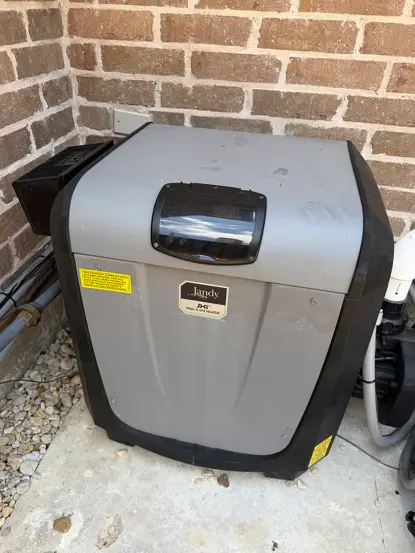
Gas equipment raises the stakes. Burner chambers run near 1,100 degrees. A heater that has been under water needs new gas controls, not a dry-out and a restart. Our technicians hold a Residential Appliance Installer License issued by the Texas Department of Licensing and Regulation, and they work through the flow path before opening the gas train.
Flow Check + Ignition Sequence + Gas and Electrical Test
+ Component Repair + Full Cycle Verification
A heater that will not fire has roughly a dozen possible causes, and most of them sit outside the cabinet. We work the sequence in order so the cheap causes get ruled out before anyone quotes a part.
Flow and Pressure Check
We confirm the pump is moving enough water to satisfy the low flow switch, and check the filter, the valve positions and the bypass adjustment.
Ignition Sequence Test
We watch the heater through a full call for heat, from thermostat close to pilot to main burner, and note exactly where the sequence stops.
Gas and Electrical Test
We check gas supply pressure, the control circuit, the thermostat calibration, the pressure switch and the high limit before condemning any component.
Component Repair
We replace only what failed. Igniters, thermocouples, pressure switches, thermostats, gas valves and heat exchangers are all serviced individually.
Full Cycle Verification
We run the heater through a complete heating cycle, confirm it reaches the set temperature and holds, and check the vent and exhaust before leaving.
Pool Heater Repair in Frisco, TX
Frisco runs a long swim season, and a heater is what stretches it into March and back out through November. When it quits, the pool goes unused. NorTex Pools handles pool heater repair on gas heaters and heat pumps across Frisco, and we service Pentair, Hayward, Jandy and Raypak equipment. All of them build to the residential standards published by the Pool & Hot Tub Alliance. Every call starts with the flow path, because that is where most heater faults actually begin.
Signs Your Pool Heater Needs Repair
Heaters rarely fail all at once. They degrade first. The early symptoms tell you a good deal about which component is drifting, and they shape what a pool heater repair will actually involve.
- The heater will not start at all
- The burner lights, then shuts down within minutes
- The water warms far more slowly than it used to
- The heater stops short of the set temperature and cycles
- An error code appears, clears on reset, then returns
- The top of the cabinet is black, or the finish looks warped
- Water is pooling under the heater
- The pilot needs relighting after rain or sprinkler use
- The temperature reading does not match the water
Short cycling and a slow warm-up point in different directions. Short cycling usually means the heater is losing flow or a switch is dropping out. A slow warm-up more often means scale on the heat exchanger, a thermostat out of calibration, or a heater undersized for the pool it was fitted to.
Why Your Gas Heater Will Not Ignite
A gas heater follows a fixed sequence every time it fires. It stops at the first condition it cannot satisfy. Every pool heater repair we run starts by working that sequence in order, because it is faster than guessing and most of it costs nothing to check.
- Is the system switch on and the thermostat calling for heat?
- Is the pump running with enough flow to keep the low flow switch closed?
- Check both gas valves, the supply valve and the one on the heater itself.
- Confirm every plumbing and filter valve is open.
- If a bypass is fitted, is it adjusted correctly?
- On a millivolt heater, is the pilot still lit?
Two ignition types are in the field and they fail differently. A millivolt heater keeps a pilot burning continuously, and a thermocouple converts that pilot heat into the small current that holds the gas valve open. When the thermocouple weakens, the valve will not stay open. An electronic ignition heater sparks the pilot on demand through a control circuit that usually runs at 25 volts AC, so its failures are electrical rather than thermal.
Pilot problems are often environmental. A pilot that will not light points to low gas pressure, inadequate air supply or a venting problem, and on propane it can simply mean an empty tank. A pilot that keeps going out usually means water is reaching it, from a roof line, a gutter or a sprinkler head aimed at the cabinet. Heaters set against a wall or in a wind channel sometimes need a high wind stack before the pilot will hold.
If you hear the igniter clicking or sparking and the burner still will not light, stop there. That fault is inside the gas train.
The Heater Runs but the Water Stays Cold
A heater that fires and never reaches temperature is usually starved, not broken. Inadequate water flow causes most of it. The usual suspects are a dirty filter, a closed valve, an external bypass out of adjustment, or reversed water connections at the heater. None of those is a pool heater repair inside the cabinet.
Two calibration faults account for most of the rest. A pressure switch out of adjustment will drop the burner out early and repeatedly. A thermostat out of calibration will report the pool as warmer than it is and stop the cycle short. Both are inexpensive to correct and neither requires replacing the heater.
Sizing is the uncomfortable answer nobody wants. If heat loss exceeds the heater input, the unit will run continuously and still lose ground on a cold night. A solar cover slows that loss considerably and will often make an undersized heater workable through a Frisco winter.
Pool Heater Leaks
Where and when the heater leaks tells you what failed. A leak that appears only while the burner is lit is frequently not a leak at all. It is condensation, which forms when the heater is warming very cold water, and it also appears when a bypass is missing or damaged, or when an oversized pump is pushing too much water through the exchanger.
A leak that runs constantly is different. The heat exchanger itself may be corroded, and low pH is the usual cause. Water that sits acidic eats the protective coating off copper, and once that is gone the exchanger is on borrowed time.
Freeze damage is the Frisco specific one. A hard January freeze cracks an exchanger quietly. Nothing shows until the system comes back up, which is why so much of our spring pool heater repair work traces to a freeze three months earlier.
Heat Pump Heaters and How They Fail
A heat pump does not burn anything. It moves heat from the outside air into the pool water using a refrigerant compression cycle, which makes it cheaper to run than gas and slower to recover. The only running cost is the electricity for the compressor.
That design also sets its limits. The amount of heat a heat pump can move depends directly on air temperature and humidity, so performance drops as the air cools. A unit that struggles on a 45 degree Frisco morning may be behaving exactly as designed rather than failing.
Real faults concentrate in the compressor, the reversing valve, the fan motor, the refrigerant charge, the water flow switch and the control board. That makes heat pump pool heater repair a largely electrical job. Electric resistance heaters are different again. They recover slowly and cost a lot to run, so they are usually spa equipment rather than pool equipment.
Error Codes and What They Actually Mean
An error code names a condition, not a part. A flow fault tells you the heater is not seeing enough water, and that could be the filter, a valve, the pump or the switch that measures it. An ignition lockout tells you the burner did not prove flame within the allowed window, which could be gas supply, the igniter, the flame sensor or the pilot.
The number narrows the search. It does not end it, and that is why clearing a code and walking away tends to fail. The heater relocks because the condition never changed.
What matters is when the code comes back. Immediately, after a few minutes, or only on cold mornings. That timing is often more useful to a pool heater repair technician than the code itself, so note it before you reset the panel.
What Frisco Water Does to a Heat Exchanger
Calcium carbonate becomes less soluble as water gets hotter. That makes the heat exchanger the first place in the system where scale forms. As it builds, the exchanger moves less heat into the water, so the heater runs longer for the same result. North Texas water makes this routine rather than occasional.
The injection point is the other quiet killer, and it is often plumbed wrong. Chemicals belong in the circulation line after every piece of equipment, heater included. Fed in ahead of the heater, concentrated disinfectant strips the coating off the exchanger and puts copper into your water. Green hair and blue staining on the plaster are the first sign.
Gas Heater Safety, and What to Leave Alone
Some of this page is worth trying yourself. This part is not. Gas pool heater repair beyond the basic checks belongs to qualified technicians. The failure modes here include fire and explosion, not an expensive repair bill.
Three rules matter more than the rest. If any part of the heater has been under water, do not operate it. Those gas controls have to come out, and drying them is not an option. If the heater overheats or the gas will not shut off, close the manual gas control valve at the heater. Keep everything off the top of the cabinet too. Blocking that airflow can damage the unit, void the warranty or start a fire.
Vent pipes, draft hoods and the heater top run hot enough to burn skin during operation. A blackened cabinet or a warped, buckled finish is a venting or gas pressure problem, and it needs a technician rather than a repaint.
FREQUENTLY ASKED QUESTIONS
Can a pool heater be repaired?
Most pool heater faults are repairs rather than replacements. Igniters, thermocouples, pressure switches, thermostats, gas valves, control boards and heat exchangers are all replaceable components, and a heater with a sound cabinet is usually worth fixing. That calculation shifts when the heat exchanger has corroded through, when parts are no longer made for the model, or when the unit was undersized for the pool from the start. NorTex Pools inspects the flow path and the gas train before recommending either, because a heater that will not fire is often a flow problem rather than a heater problem.
What is the average cost to repair a pool heater?
NorTex Pools charges a flat $150 service call in Frisco that covers arrival, full equipment inspection and a written diagnosis, and that fee applies toward the repair if you proceed. Weekly maintenance plan members pay $135. Parts set the rest of the price, and the range is wide, from an inexpensive thermocouple or pressure switch up to a heat exchanger. Before you book anything, check that the system switch is on, the thermostat is calling for heat, the gas supply valve is open and the filter is clean. Those four checks cost nothing and they resolve a fair number of the calls we take.
Can an electrician fix a pool heater?
An electrician can correct the power supply, bonding and wiring faults that stop a heater from starting, but gas train work sits outside that trade. Igniters, gas valves, pilot assemblies, pressure switches and venting need a technician licensed for gas appliance work, and doing that work incorrectly risks fire or explosion rather than a failed repair. Heat pumps are the middle ground, since their faults are largely electrical and refrigerant related. The practical answer is to have whoever attends diagnose the flow path first, because that is where the fault usually is regardless of trade.
What is the life expectancy of a pool heater?
A gas pool heater generally lasts seven to twelve years, and a heat pump often longer because it has no combustion chamber to corrode. Water chemistry decides most of it. Water held acidic strips the protective coating off a copper heat exchanger, and chemicals injected ahead of the heater rather than after it will destroy an exchanger in a fraction of its expected life. Frisco's hard water works the other way and coats the exchanger in scale, which reduces efficiency long before it causes a failure. Heaters that are balanced and plumbed correctly reach the top of that range, and they need far less pool heater repair along the way.
Why does my pool heater keep shutting off before it reaches temperature?
A heater that fires and then drops out is almost always losing water flow rather than failing internally. The usual causes are a dirty filter, a closed or partly closed valve, an external bypass out of adjustment, or reversed water connections at the heater. A pressure switch out of adjustment produces the same symptom, as does a thermostat out of calibration that reports the water warmer than it is. The heater is shutting down to protect itself, so resetting it repeatedly treats the symptom and leaves the restriction in place. A pool heater repair that skips the flow check will not hold.