
Pool Heater Installation in Frisco, TX
Sized to Your Surface Area
Gas heaters and heat pumps, sized by BTU and surface heat loss. Installed properly and commissioned before we leave.
Response Time 1 to 2 Hours
Pools Lose Heat Through
the Surface
Licensed technicians who run the BTU numbers before recommending equipment
Heater sizing has an actual formula. Take your gallons, multiply by 8.33, multiply by the temperature rise you want. That gives the BTUs required. A 40,000 gallon pool lifted six degrees needs close to two million of them. One calculation rules out most of the guesswork.
Then comes the part almost nobody accounts for. A pool loses its heat through the surface. Surface area drives the ongoing demand far more than volume does. Two pools holding the same water can need very different heaters if one is long and shallow and the other is compact and deep.
Wind exposure, shade and whether you use a cover all move the number again. We work through those before recommending equipment, because a pool heater installation sized on volume alone tends to disappoint in November. Our technicians hold a Residential Appliance Installer License issued by the Texas Department of Licensing and Regulation.
Heat Load Calculation + Fuel and Supply Check + Equipment Selection
+ Installation and Plumbing + Commissioning
The order matters. Working out the heat load first means the equipment choice follows from numbers rather than from whatever the supplier has in stock this week.
Heat Load Calculation
We calculate the BTUs your pool needs from volume, surface area, the temperature rise you want, and how exposed the pool sits.
Fuel and Supply Check
Gas line capacity, meter sizing and available electrical supply all get verified, since these frequently decide which equipment is even possible.
Equipment Selection
We match a gas heater or heat pump to the calculated load, then confirm it suits your circulation flow rate and available space.
Installation and Plumbing
The unit gets set on a level base with correct clearances, plumbed with unions and a bypass, and connected to fuel or power.
Commissioning
We run a full heating cycle, confirm the temperature rise against the calculation, and set the controls before handing it over.
Pool Heater Installation in Frisco, TX
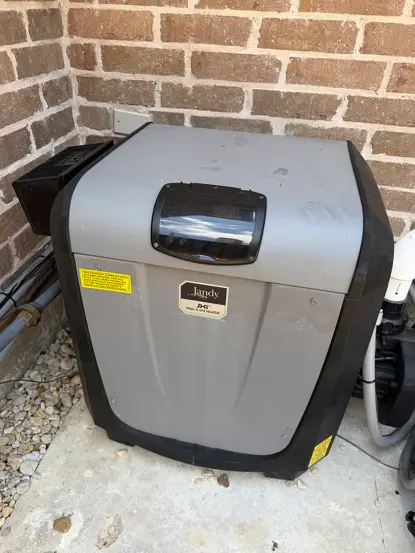
Frisco gives you a long swim season and then takes six weeks off it at each end. A heater buys those weeks back. NorTex Pools handles pool heater installation across Frisco on gas equipment and heat pumps, and we work with Pentair, Hayward, Jandy and Raypak. All build to the residential standards published by the Pool & Hot Tub Alliance. Every quote starts with a heat load calculation rather than a model number.
Gas Heater or Heat Pump
These two solve the same problem in opposite ways. The right answer depends on how you plan to use the pool.
A gas heater delivers heat fast. It suits people who swim on impulse and want the pool warm by evening. You pay more per hour for that speed. Cold weather barely affects it.
A heat pump moves heat out of the air instead of making it. Running costs are a fraction of gas. The trade is speed and weather sensitivity. It recovers slowly and its output drops as the air cools. That suits a pool held at temperature all season rather than one warmed from cold on a Friday.
- Swim occasionally and want it hot by tonight, choose gas
- Swim regularly and hold a temperature all season, choose a heat pump
- Want the shoulder months of March and November, gas handles them better
- Care most about running cost across a full season, the heat pump wins clearly
How Heater Size Is Calculated
The arithmetic is simple enough to check yourself. BTUs equal gallons multiplied by 8.33 multiplied by the temperature rise in Fahrenheit.
Take a 40,000 gallon pool you want lifted from 74 to 80 degrees. That is 40,000 times 8.33 times 6. The answer is 1,999,200 BTUs to make the lift. Divide that by a heater output and you have the hours it will take.
Undersizing and oversizing fail differently. Too small and the pool takes so long to warm that people stop using the heater. Too large and it works fine, it just cost more than it needed to. Err upward if you must, but start from the calculation.
Why Surface Area Matters More Than Volume
A pool sheds nearly all its heat through the surface, where water meets air. That makes surface area the number that governs how much heat you have to keep replacing.
The distinction that follows is useful. Holding a temperature all season means sizing around surface area. Heating intermittently and letting the pool cool between uses puts the weight on volume, because you pay to lift the whole body of water each time.
Maintaining a temperature takes far less energy than the initial heat up. That is why an honest pool heater installation quote asks how you actually intend to swim before it recommends a size.
What a Pool Cover Does to the Numbers
This is the largest variable on the page. It also costs less than any equipment discussed here.
An uncovered pool can lose as much as half its total temperature rise in bad conditions. Covered, that loss drops to somewhere between fifteen and twenty-five percent. Same heater, a fraction of the workload.
The consequence is worth stating plainly. Buying a cover often does more for pool temperature than moving up a heater size, and it does it for a fraction of the money. We would rather size the heater correctly and have you cover the pool than sell you capacity to fight evaporation.
Pool Heat Pump Installation
A heat pump extracts warmth from the outside air and moves it into the water using a refrigerant cycle. It creates no heat of its own, which is exactly why it runs so cheaply. The only real running cost is electricity for the compressor.
Pool heat pump installation places demands that gas does not. The unit works by pulling large volumes of air across a coil, so it needs clear air around it. Box one into a fence corner and you choke its output. It also needs a dedicated electrical circuit sized to the unit rather than a spare breaker.
Output falls as air temperature falls, which is worth knowing before January. In Frisco a heat pump holds a comfortable pool through most of the season and struggles in a real cold snap. Some homeowners solve that by pairing one with a gas unit for the extremes.
Gas Supply, Clearances and Venting
The gas line is the constraint that surprises people. A pool heater demands a serious volume of gas. An existing line sized for a house often cannot feed it alongside everything else, and undersized supply produces a heater that never reaches its rated output.
Meter capacity is the second half of that question. Between the meter and the pipe run, gas availability sometimes decides which heater size is realistic, whatever the pool calculation asked for.
Clearances and venting are code matters rather than preferences. The unit needs space around it and clear air above. It cannot sit where a wall or fence drives exhaust back down into the cabinet.
Matching the Heater to Your Circulation
A heater sits last in the circulation loop. Whatever the pump and filter deliver is what it has to work with. Every heater has a flow range it needs, and fitting one without checking that the system delivers it creates problems on day one.
A bypass earns its place here. It routes some flow around the heater, which protects the unit. It also lets you service the heater without shutting the whole pool down.
Altitude turns up in every sizing guide, so it deserves a note. Heater output requirements rise about four percent per thousand feet above sea level. Frisco sits near seven hundred feet, so the adjustment is small. It matters in Colorado. It barely matters here.
What Installation Day Involves
Most heater installations take a day. The old unit comes out and the pad gets prepared. We set the new heater level, with its required clearances, before connecting anything.
- Plumbing tied in with unions either side for future service
- A bypass fitted so flow can be regulated and the unit isolated
- Gas line connected and pressure tested, or the electrical circuit run and terminated
- Venting and clearances confirmed against the manufacturer requirements
- Controls wired and integrated with your existing equipment where compatible
- A full heating cycle run and the temperature rise measured against the calculation
That last step is the one people skip. A pool heater installation that has not been run through a complete cycle and measured is a guess wearing a receipt.
FREQUENTLY ASKED QUESTIONS
What size pool heater do I need?
Heater size comes from a formula rather than a rule of thumb. BTUs equal your pool volume in gallons multiplied by 8.33 multiplied by the temperature rise you want in Fahrenheit. A 40,000 gallon pool raised six degrees needs roughly two million BTUs of energy, and dividing that by a heater output gives the heat up time. Surface area then adjusts the answer, because pools lose heat through the surface rather than through volume. Wind exposure, shade and whether you use a cover all shift the requirement further.
How much does it cost to install a pool heater?
NorTex Pools charges a flat $150 service call in Frisco covering arrival, full site assessment and a written quote, and that fee applies toward the installation if you proceed. Weekly maintenance plan members pay $135. The equipment sets most of the cost, and the site decides the rest. A gas heater needs a supply line capable of feeding it, and an undersized existing line adds meaningful expense. A heat pump needs a dedicated electrical circuit. Both of those get checked during the assessment rather than discovered on installation day.
Is a heat pump or a gas heater better for a pool?
Neither is better in general, and the honest answer depends on how you swim. Gas heats fast and works in cold weather, which suits people who decide to swim that evening and want the pool ready. A heat pump costs a fraction as much to run but recovers slowly and loses output as air temperature drops, which suits a pool held at a steady temperature through the season. A useful test is whether you plan to heat from cold on demand or maintain a temperature continuously.
How long does it take to heat a pool?
Heat up time is the required BTUs divided by the heater output per hour. A gas heater typically lifts a residential pool several degrees within hours. A heat pump doing the same job works in days. Maintaining a temperature takes far less energy than the initial lift, so the first heat of the season is always the slow one. Conditions change the answer a lot. Wind and an uncovered surface fight the heater the entire time, which is why a pool heater installation is sized around exposure rather than gallons alone.
Does a pool cover actually make a difference?
A cover makes more difference than almost any equipment decision on this page. An uncovered pool can lose up to half of its total temperature rise under poor conditions, and covering it brings that loss down to roughly fifteen to twenty-five percent. In practical terms a cover often outperforms moving up a heater size, at a fraction of the cost. Anyone quoting a larger heater without asking whether you use a cover is solving the problem the expensive way round. A good pool heater installation quote raises the cover before it raises the size.