
Pool Pump Installation in Frisco, TX
Sized From the Numbers
We size a new pump from your turnover rate and total dynamic head, then install it and prove the flow.
Response Time 1 to 2 Hours
Most Pumps Are Sized
From the Old Label
Licensed technicians who calculate the flow before choosing the pump
Ask most companies what pump you need and they will read the sticker on the one you have. That works only if the original was right, and plenty were not. Pools get resurfaced, plumbing gets altered, filters get changed, and the old pump stops matching the pool it serves.
A pump has one job: move your pool volume through the filter often enough to keep the water clean. One turnover filters about 63 percent of the water. A second takes the unfiltered share to 14 percent. A third takes it to 5, a fourth to 2. That is the arithmetic a pool pump replacement should start from.
The second number is total dynamic head. That is every bit of resistance the water fights on its way round: pipe, fittings, the filter, the heater, the returns. We measure it rather than estimate it. Our technicians hold a Residential Appliance Installer License issued by the Texas Department of Licensing and Regulation.
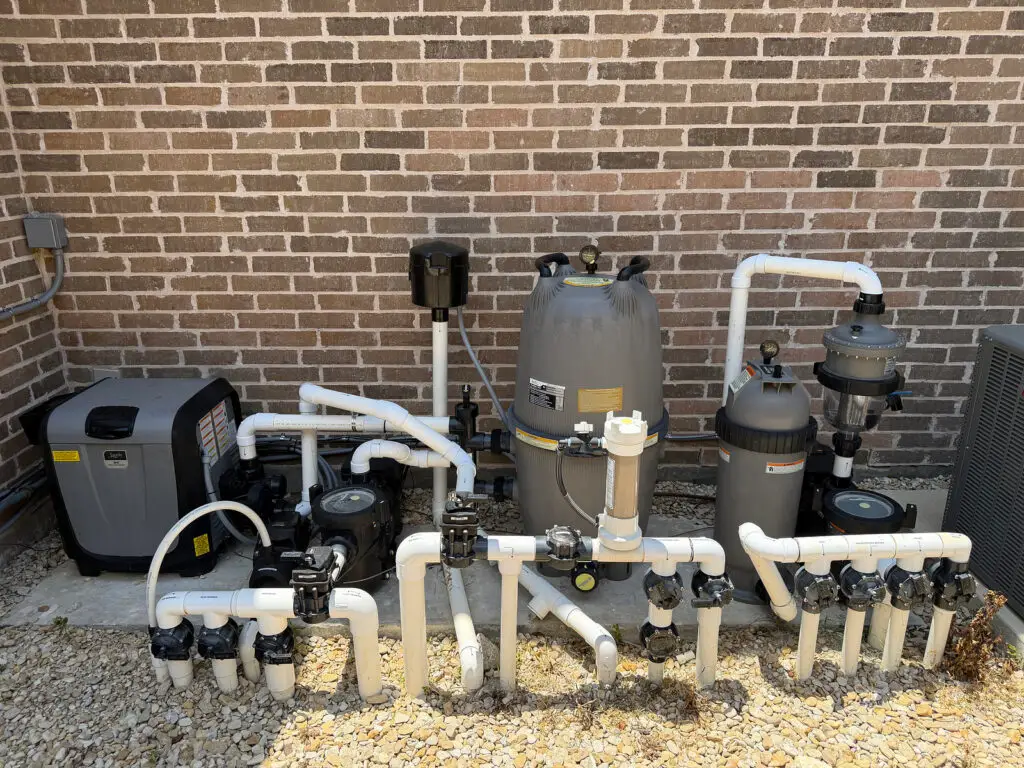
Flow Calculation + Head Measurement + Pump Selection
+ Plumbing and Electrical + Flow Verification
Fitting a pump takes an afternoon. Choosing the right one takes two measurements and ten minutes of arithmetic, and it decides whether you are happy with the result for the next decade.
Flow Calculation
We work out your pool volume and the flow rate needed to turn that volume over often enough for the way you actually use the pool.
Head Measurement
Vacuum and pressure gauge readings give us the real resistance in your plumbing, taken with a clean filter so the number means something.
Pump Selection
We choose a pump whose curve meets that flow at that head, then confirm it suits the filter, the plumbing size and the supply voltage.
Plumbing and Electrical
The pump gets set level, plumbed with proper unions for future service, and wired to the correct voltage with the terminals configured to match.
Flow Verification
We prime the system, read both gauges again, confirm the pump hits its design flow, and set the speed schedule before we leave.
Pool Pump Installation in Frisco, TX
A pump decides two things: how clean your water gets, and how much you pay to keep it that way. NorTex Pools handles pool pump replacement and new installations across Frisco on Pentair, Hayward and Jandy equipment. All three build to the residential standards published by the Pool & Hot Tub Alliance. We size every pump from measured numbers rather than from the label on the failed one.
When Replacement Beats Another Repair
Plenty of pump faults are worth fixing. Seals, capacitors, o-rings and impellers all replace cheaply. A full pool pump replacement earns its place when the economics stop working.
- The motor has burned out and the pump is already several seasons old
- Repairs are stacking up two or three times a season
- The housing or volute has cracked
- Parts for the model are no longer made
- The pump was wrong for the pool from the day it went in
- You are changing the filter or adding water features, so the flow requirement is changing anyway
- The pump runs at one speed and your run hours are long
That last one is worth its own thought. A single speed pump has no cheap mode. A Frisco pool running long hours through summer costs the same every hour it runs. Plenty of pool pump replacement jobs are justified by run cost alone, before anything has broken.
How a Pool Pump Is Actually Sized
Sizing starts with turnover. That is how long the pump takes to push a volume equal to the whole pool through the filter. The arithmetic behind it is more interesting than it sounds, because water mixes rather than queues.
One full turnover filters roughly 63 percent of the water molecules. It leaves 37 percent untouched. A second turnover cuts the unfiltered share to 14 percent, a third to 5 percent, and only after a fourth does it reach 2 percent, which is the standard many codes hold commercial pools to daily.
That is why turnover targets exist and why guessing at them produces cloudy water. Divide your pool volume by the hours you want a turnover to take, convert to gallons per minute, and you have the flow figure the pump has to deliver. Everything else follows from that number.
Total Dynamic Head, and Why the Old Label Lies
Flow alone does not select a pump. A pump only produces a given flow against a given resistance. That resistance has a name: total dynamic head. Every pipe run, elbow, valve, the filter, the heater and the height of the return fittings all add to it.
You can measure it rather than guess. Multiply the vacuum gauge reading by 1.133 for the suction side head. Multiply the pressure gauge by 2.31 for the discharge side. Add the two and you have what the system genuinely demands. Take the reading with a clean filter or the number means nothing.
Horsepower on the old pump tells you nothing about this. Two pumps of identical horsepower can deliver very different flow at the same head, which is why a pool pump replacement chosen by matching the sticker so often disappoints.
Variable Speed and the Efficiency Rules
Variable speed pumps have gone from premium option to default. Regulation is part of why. Energy rules adopted in several states now require pool pump motors of one horsepower or more to run at two or more speeds, and the low speed can be no faster than half the motor maximum.
The reason is physics rather than politics. Halving pump speed cuts power draw by far more than half. Filtering slowly over longer hours costs a fraction of filtering quickly over fewer. The pump moves the same water and uses much less doing it.
Sizing still matters on a variable speed pump. A unit that is too large simply runs at a lower speed to compensate, which works, but you paid for capacity you will never use.
Matching the Pump to the Filter
The filter sets a ceiling the pump has to respect. Every filter has a maximum flow its media area can handle. Push past it and dirt drives deep into the media instead of catching at the surface. On sand it also causes channeling, where water carves a path through the bed and skips filtration entirely.
Undersizing fails more quietly. Too little flow means the pool never completes enough turnovers, and the water stays slightly cloudy whatever chemistry you run.
This is why we check the filter before the pump. A pool pump replacement that ignores the filter rating either overwhelms good filtration or wastes it.
Plumbing the New Pump
Plumbing decides whether the next service call is easy or expensive. Unions either side of the pump let the whole unit come out without cutting pipe. Skip them and a twenty minute job becomes a plumbing job. That matters more than it sounds on a pad with no spare room.
Pipe size deserves attention too. Suction plumbing that is undersized for the new flow creates velocity, noise and head loss, and it starves the impeller in exactly the way that shortens pump life.
The pump also has to sit level and low enough to draw water reliably. Valve positions should let you isolate the system without draining half the equipment pad.
Voltage, Nameplate and One Obsolete Standard
Pool pump motors normally run at 115 or 230 volts single phase. Most accept either. The terminals inside the motor have to match whichever supply is actually present, and getting that wrong damages the motor on start-up.
One older standard catches people out. The 230/460 volt arrangement found on some larger installations is obsolete, and it matters at replacement time because the modern equivalent will not simply drop into place.
Photograph the motor nameplate before anything comes out. It carries the horsepower, service factor, voltage and frame details that any correct replacement depends on, and it is the first thing that becomes unreadable once corrosion sets in.
Why Oversizing Is the Expensive Mistake
Bigger pumps feel like insurance and behave like a penalty. Motors and impellers come matched, so the impeller loads the motor to its service factor horsepower. Stepping up one size breaks that pairing.
Push more water through suction plumbing that was never built for it and you raise the risk of suction entrapment, the exact hazard federal pool safety law addresses. Any pump change should include verifying total dynamic head and the resulting flow rate so the installation stays compliant.
The downstream costs pile up quietly. Higher velocity through the filter. More noise. An electricity bill that never comes back down. A correctly sized pool pump replacement beats an oversized one on every measure that matters.
FREQUENTLY ASKED QUESTIONS
How do I know what size pool pump I need?
Pump size comes from two numbers, and neither is the horsepower on your old pump. The first is the flow rate your pool needs. Divide pool volume by the hours you want one turnover to take. The second is total dynamic head, the resistance in your plumbing. You read it off the vacuum and pressure gauges with a clean filter. A pump is correctly sized when its performance curve delivers that flow at that head. Horsepower on the old unit tells you very little, because two pumps of equal horsepower can move very different volumes.
How much does it cost to install a new pool pump?
NorTex Pools charges a flat $150 service call in Frisco covering arrival, full inspection and a written diagnosis, and that fee applies toward the work if you proceed. Weekly maintenance plan members pay $135. The pump itself sets most of the cost, and a variable speed unit runs considerably higher than a single speed of the same capacity. Before committing to a replacement, it is worth confirming the old pump has genuinely failed, because a seized impeller, a failed capacitor or a worn seal are all repairs rather than replacements.
Is a variable speed pool pump worth it?
A variable speed pump pays for itself only if you actually run it slowly. Power draw falls much faster than speed does, so filtering at low speed over longer hours costs a fraction of filtering at full speed over short ones. Set to maximum and left there, a variable speed pump saves almost nothing. You have paid a premium for a dial nobody turned. The savings are real when the schedule is set properly, and energy rules in several states now require multi speed capability on motors of one horsepower or more.
Can I install a pool pump myself?
Swapping a pump physically is within reach of a capable homeowner, and the plumbing is straightforward if unions are already fitted. The parts that are not straightforward are sizing it and wiring it. Most pool motors accept two voltages. The internal terminals have to match the supply actually present, and getting that wrong destroys the motor on start-up. Sizing is the bigger risk, because an oversized pump pushes more water through suction plumbing than it was designed for and raises entrapment risk rather than improving circulation.
How long should a pool pump last?
A well matched pool pump generally runs eight to twelve years, and installation quality decides where in that range it lands. Oversizing is the most common shortener. A pump moving more water than the plumbing was built for runs everything at higher velocity, and higher velocity wears every component faster. Undersized suction pipe does the same. Long daily run hours at full speed add heat the motor never sheds. A pool pump replacement sized from measured flow and head, plumbed in the right pipe diameter and run on a sensible schedule reaches the top of that range.