
Pool Light Installation in Frisco TX
Wired to Code, Every Time
LED upgrades, failed fixtures and niche work, with GFCI protection and bonding verified before we energise anything.
Response Time 1 to 2 Hours
The Most Dangerous Fixture
In Your Pool
Licensed technicians who check the bonding grid before touching the niche
An underwater light is the single most dangerous piece of equipment in a swimming pool. Water and wet skin form a low resistance path to ground, so a fault inside that fixture has somewhere to go, and a swimmer can become the route it takes.
The numbers behind that are worth knowing. A ground fault interrupter trips at around 5 milliamperes. Muscle control starts to go at 10. At 18 milliamperes the chest muscles can lock and breathing stops. The gap between a working GFCI and a fatal one is that small.
So a pool light replacement is an electrical job wearing a decorative disguise. We verify the GFCI, check the bonding grid, inspect the niche and the conduit, and confirm the fixture matches the supply before anything gets energised. Our technicians hold a Residential Appliance Installer License issued by the Texas Department of Licensing and Regulation.
Circuit Test + Niche and Conduit Inspection + Fixture Fitting
+ Bonding Verification + Energized Check
Every light job runs the same order, and the electrical checks come before the fixture, not after. A light that works is easy. A light that works safely takes four checks nobody sees.
Circuit and GFCI Test
We confirm the lighting circuit has working ground fault protection and identify the supply voltage before anything comes out of the wall.
Niche and Conduit Inspection
The niche gets checked for corrosion and a sound seal, and we inspect the conduit run and junction box for water intrusion.
Fixture Fitting
We match the new fixture to the niche, the voltage and the cord length, then seat it with a fresh gasket and the correct hardware.
Bonding Verification
We confirm the fixture and niche are tied into the pool bonding grid, so every metal component sits at the same electrical potential.
Energised Check
Power goes on last. We test the GFCI trips, confirm colour and control functions, and check the seal before the light goes back under water.
Pool Light Installation in Frisco, TX
A pool looks like a different property after dark, and the light in the wall decides which one you get. NorTex Pools handles pool light replacement and new fixture installation across Frisco, on Pentair, Hayward and Jandy equipment. All three build to the residential standards published by the Pool & Hot Tub Alliance. Every job begins at the breaker panel rather than the pool wall.
Signs Your Pool Light Needs Replacing
Lights fail in ways that look cosmetic and are not. Some of these mean stop using the light today.
- The light will not come on at all
- It flickers, or the colour drifts and will not hold
- The breaker or GFCI trips when the light is switched on
- Water is visible inside the lens
- The lens is cracked, clouded or discoloured
- There is corrosion on the fixture body or the securing screw
- Output has dimmed noticeably over a season
- The fixture will not stay seated in the niche
Three of those are urgent. A tripping breaker, water inside the lens and visible corrosion all indicate the fixture has lost its seal. Switch that circuit off and leave it off. A GFCI tripping is the device doing its job, and treating it as a nuisance by resetting it repeatedly removes the only protection between the fault and a swimmer.
What a Pool Light Replacement Actually Involves
Homeowners picture a bulb. In practice the job reaches further, because everything around that bulb ages at the same rate.
- The fixture or lamp assembly itself
- The lens gasket, which hardens and stops sealing
- The face ring and securing screw, often seized with corrosion
- The cord, which has to be long enough to bring the fixture onto the deck
- The niche and its conduit connection
- The deck junction box, where water intrusion frequently starts
- The transformer on low voltage systems
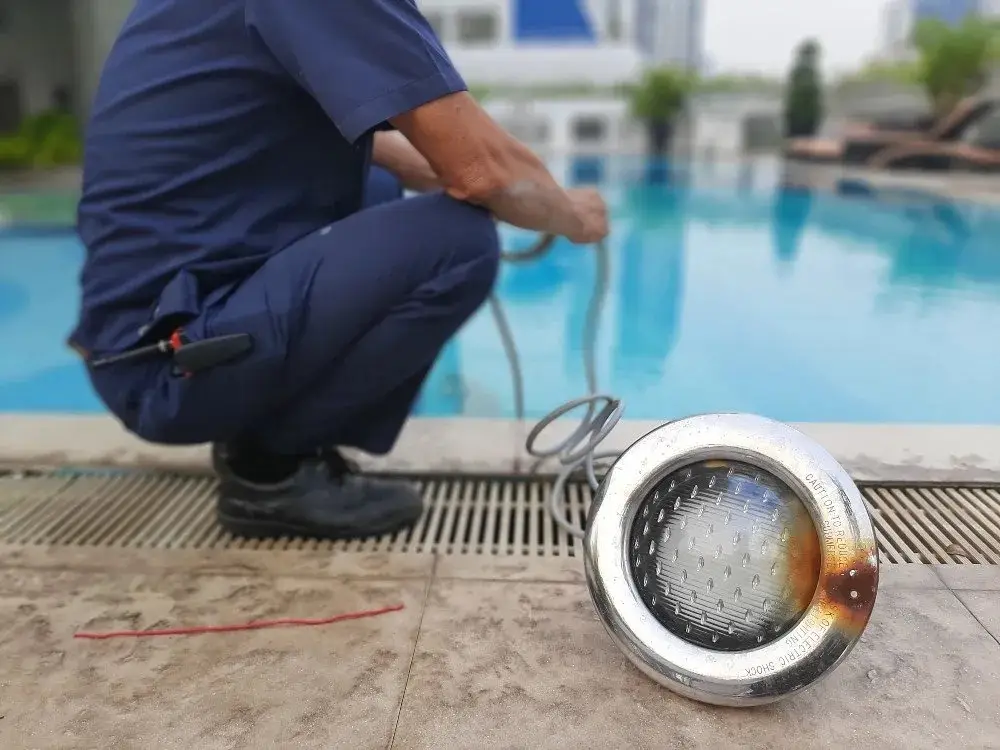
Cord length catches people out more than anything else. The fixture has to reach the deck before anyone can work on it, so the cord runs long and coils behind the light. Cut that cord short and the next service call needs a drained pool, which turns a routine job into an expensive one.
Upgrading to LED
An LED pool light replacement is the most common upgrade we fit. On an older pool the difference is dramatic. A single LED fixture draws a fraction of the power of the incandescent it replaces, and it puts far more usable light into the water.
The practical gains matter more than the marketing ones. LED fixtures run cooler, which is easier on the niche and the gasket. They last years rather than seasons. And colour is built into the fixture rather than achieved with a filter, so it does not fade.
Check compatibility first. The niche, the supply voltage, the existing conduit and any transformer all have to suit the new fixture. A pool light replacement that ignores one of those tends to fail early.
Retrofitting an Older Frisco Pool
Frisco has pools of every vintage, and the older neighbourhoods hold the interesting problems. A pool built in the 1990s may still run its original niche, its original conduit and an unprotected lighting circuit.
That last point is the one to take seriously. Pools more than thirty years old frequently have no ground fault protection on the underwater lighting circuit at all, because it was not required when they were built. The light works, the pool looks fine, and there is nothing between a failed fixture and the water.
We check for that before quoting a fixture. Adding GFCI protection to an older lighting circuit is straightforward work, and on a pool of that age it is worth considerably more than the light itself.
GFCI Protection and the 15 Volt Rule
Electrical code sets a clear line for underwater lighting. Any underwater fixture operating at more than 15 volts requires ground fault protection, without exception.
A GFCI compares current going out with current coming back. When those differ by roughly 5 milliamperes, something is leaking to ground and the device opens the circuit. That threshold sits well below the level at which current turns dangerous. That is the entire point of it.
Low voltage fixtures sit below that threshold, which is one reason twelve volt systems are common in newer builds. Voltage alone does not remove the need for correct bonding. We test the protection rather than assume it works.
Bonding, Grounding and Why Both Matter
People use these two words interchangeably. They do different jobs. Grounding gives fault current a low resistance path back to earth. Bonding ties every metal component together so they all sit at the same electrical potential, and no voltage difference exists for a swimmer to bridge.
Code requires bonding across all metal parts of the pool structure, including the reinforcing steel in the shell and the deck. Grounding covers the electrical side. That means wet and dry niche lighting, junction boxes, transformer enclosures, circuit boards, and any equipment within five feet of the pool wall.
Bonding also disappears from view once a pool is finished, which is why it gets missed. A fixture fitted without reconnecting it to the bonding grid looks identical to one fitted correctly, and behaves identically until the day it does not.
Colour Changing Lights and Controls
Colour changing LED fixtures shifted from luxury to standard over the last decade. Most offer fixed colours, transition shows and dimming. How you control them depends on the fixture family rather than the pool.
Some systems switch colours by cycling power at the breaker or switch, which is why an unfamiliar light sometimes changes colour when a homeowner flicks it off and on. Others use a dedicated controller, and most current fixtures will also take commands from a compatible pool controller if one is already fitted.
Matching fixtures matters if you light more than one thing. Two lights from different families will not synchronise. A pool and spa on mismatched fixtures drift out of step and stay that way.
Why This Is the One Job to Leave Alone
Plenty of pool work is reasonable to attempt. This is the exception, and the reason is arithmetic rather than opinion.
A ground fault device opens at about 5 milliamperes. Muscle control starts to fail near 10. That is the point where a person can no longer let go of what is shocking them. At 18 the chest muscles can contract hard enough to stop breathing, and unconsciousness follows if the current holds. Those numbers sit close together. Pool water and wet skin strip away the resistance that would otherwise protect you.
A pool light replacement starts at the panel, because turning the switch off does not isolate the circuit. If a fixture flickers, trips a breaker or holds water behind the lens, switch off the circuit at the panel and leave the light out of service until a proper pool light replacement happens.
FREQUENTLY ASKED QUESTIONS
Can you replace a pool light without draining the pool?
Yes, almost every pool light replacement is done with the pool full. The fixture comes out of its niche and up onto the deck on its own cord, which runs long and coils behind the light for exactly this reason. We isolate the circuit at the panel first, unscrew the fixture and lift it out, then do the work on dry decking. Draining only becomes necessary when the niche itself is damaged or the conduit needs replacing, which is uncommon.
How much does it cost to replace a pool light?
NorTex Pools charges a flat $150 service call in Frisco covering arrival, full inspection and a written diagnosis, and that fee applies toward the work if you proceed. Weekly maintenance plan members pay $135. The fixture sets the rest of the price, and an LED colour changing unit costs considerably more than a plain white replacement. Before booking, check whether the breaker or GFCI has tripped and whether the light is on a switch you may have missed. Those cost nothing and occasionally solve the problem outright.
How long do LED pool lights last?
A quality LED pool light typically lasts several years of normal use, far longer than the incandescent fixtures they replaced, because they run cooler and have no filament to fail. Water ends their life, not the diodes. The lens gasket hardens over time. Once that seal goes, water reaches the fixture and finishes it. Fit a fresh gasket every time the fixture comes out of the niche. It takes minutes and it is the cheapest protection a light can get.
Do pool lights need a GFCI?
Any underwater pool light operating at more than 15 volts requires ground fault protection under electrical code. A GFCI compares current leaving the circuit with current returning, and opens it when the difference reaches roughly 5 milliamperes, which is well below the level at which current becomes dangerous. Older pools are the concern. A pool built more than thirty years ago often has no ground fault protection on its lighting circuit at all. Nobody required it then, and the pool gives no sign of it now. Confirming that is part of any pool light replacement we quote on an older property.
Can I replace a pool light myself?
Changing a bulb in a low voltage fixture is within reach of a competent homeowner, and there is no reason to pretend otherwise. The niche, the bonding grid and the supply circuit are a different matter. Bonding ties every metal part of the pool to the same electrical potential, so no voltage difference exists for a swimmer to bridge. A fixture refitted without reconnecting it looks completely normal. If the breaker trips, if water sits behind the lens, or if the pool predates ground fault protection, stop there and book a pool light replacement.