DE Filter vs. Cartridge Filter
When it comes to keeping your pool water crystal clear, the filter you choose makes a big difference. The two most popular options for Frisco homeowners are the DE (Diatomaceous Earth) filter and the cartridge filter. Both do a great job — but they work differently, require different maintenance, and suit different pool owners.
At NorTex Pools, we install, service, and replace both types across Frisco every week. In this guide, we’ll give you a straight, honest comparison so you can choose the filter that fits your pool, your schedule, and your budget.
Meet the Two Filters
DE Filter
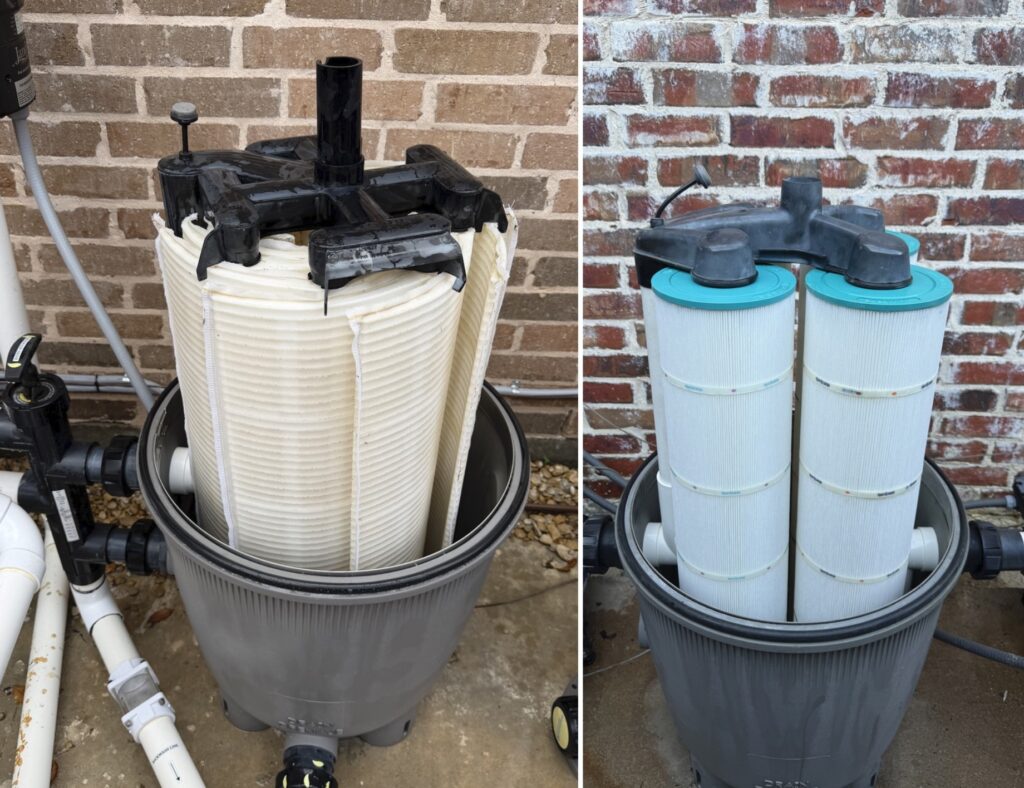
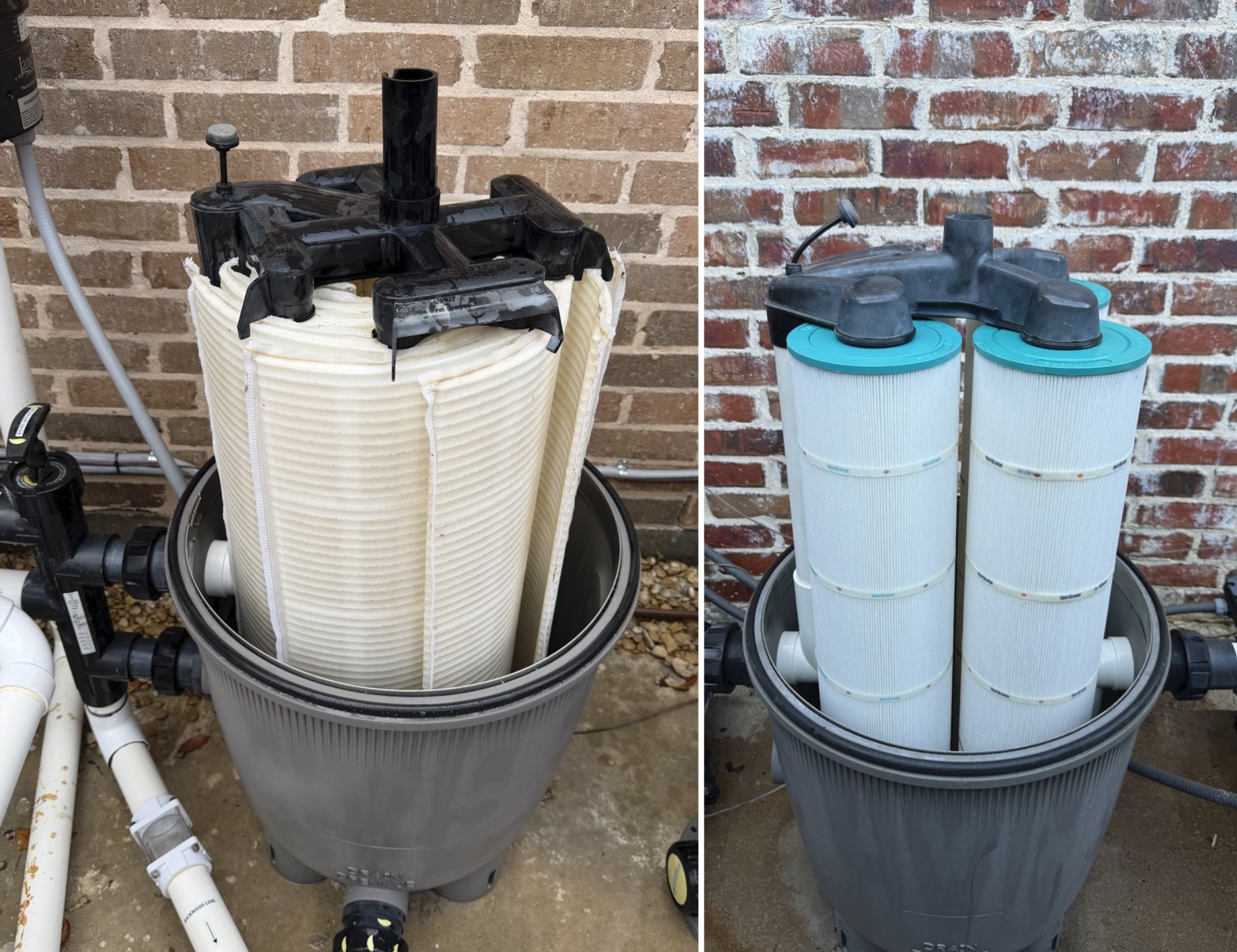
DE filters use a fine powder made from fossilized algae (diatomaceous earth) coated onto internal grids. They offer the finest filtration available for residential pools, capable of capturing particles as small as 2–5 microns.
- ✔Best filtration quality available
- ✔Crystal-clear water results
- ✔Can be backwashed for quick cleaning
- ✖Requires DE powder recharging
- ✖More involved maintenance routine
- ✖Higher upfront cost
Cartridge Filter
Cartridge filters use pleated polyester fabric to trap debris and contaminants. They filter particles down to 10–15 microns and are known for being lower maintenance and more water-efficient than DE filters.
- ✔Easy to clean — no backwashing needed
- ✔Water-efficient (no backwash waste)
- ✔Lower upfront cost
- ✖Less fine filtration than DE
- ✖Cartridges must be replaced every ~5 yrs
- ✖Cannot be backwashed
DE Filter — Everything You Need to Know
How a DE Filter Works
Inside a DE filter, water passes through fabric-covered grids coated with diatomaceous earth powder. The DE powder acts as the actual filter medium — trapping particles as small as 2–5 microns, including fine algae, dust, and debris that other filter types simply pass through.
When the filter gets dirty and pressure rises, you backwash it to flush out the used DE, then recharge the grids with fresh DE powder. A full disassembly and deep cleaning of the grids, manifold, and O-rings is recommended every 6 months.
- Finest filtration of any residential filter — 2 to 5 microns
- Produces noticeably clearer, sparkling water
- Backwashing is quick and easy for routine cleaning
- Large filter surface area handles heavy debris loads well
- Requires purchasing and adding DE powder after each backwash
- Full disassembly cleaning needed every 6 months
- Backwashing uses water and can raise pool chemical demand
- DE powder must be handled carefully and disposed of properly
Cartridge Filter — Everything You Need to Know
How a Cartridge Filter Works
Cartridge filters push water through one or more large pleated polyester fabric cylinders. The pleated design creates a large surface area that traps dirt, oils, sunscreen residue, and debris down to about 10–15 microns. When dirty, you remove the cartridges and hose them down or soak them in a cleaning solution.
Because they don’t backwash, cartridge filters use significantly less water — a real advantage in North Texas where water conservation matters. The cartridges themselves typically last 5 years before needing replacement.
- No backwashing — saves thousands of gallons of water per year
- Simple cleaning process — remove, rinse, reinstall
- Lower upfront equipment cost
- No DE powder to purchase or handle
- Quiet, low-pressure operation
- Filters to 10–15 microns — less fine than DE
- Cannot be backwashed — must be manually cleaned every 3 months
- Cartridges degrade over time and need replacement every ~5 years
- Oil and sunscreen buildup can reduce effectiveness over time
DE vs. Cartridge Filter Full Comparison
| Category | DE Filter | Cartridge Filter | Winner |
|---|---|---|---|
| Filtration Fineness | 2–5 microns | 10–15 microns | DE Filter |
| Water Clarity | Exceptional — sparkling clear | Very good — clean and clear | DE Filter |
| Routine Cleaning | Backwash + recharge DE powder | Remove and rinse cartridges | Cartridge |
| Cleaning Frequency | Every 4 weeks | Every 3 months | Cartridge |
| Deep Clean | Every 6 months (disassembly) | Every 3 months (disassembly) | DE Filter |
| Water Usage | Uses water for backwashing | No backwash — very water-efficient | Cartridge |
| Ongoing Supplies | DE powder needed after each backwash | No powder; cartridge replaced every ~5 yrs | Cartridge |
| Filter Housing Lifespan | 8–10 years | 8–10 years | Equal |
| Internal Element Lifespan | 5 years (grids) | 5 years (cartridges) | Equal |
| Best For | Owners who want the clearest water possible | Owners who want simpler, lower-maintenance filtration | Depends on you |
Which Filter Is Right for You?
You want the absolute clearest water possible and don’t mind a slightly more involved maintenance routine. DE filters are ideal for pools that get heavy use, are exposed to a lot of pollen or fine debris (common in Frisco), or for homeowners who want showroom-quality water year-round. If water clarity is your top priority, DE wins.
You want simpler, lower-maintenance filtration without dealing with DE powder or frequent backwashing. Cartridge filters are great for smaller pools, families who want a set-it-and-forget-it approach, and anyone concerned about water conservation. They still produce excellent water quality — just not quite at the DE level.
Not Sure Which Filter Is Right for Your Pool?
The NorTex Pools team can evaluate your pool size, usage, and water conditions and recommend the best filter for your specific situation in Frisco.
📞 Call (469) 238-2660Search
Categories
Recent Posts
DE Filter vs. Cartridge Filter
When it comes to keeping your pool water crystal clear, …
How Long Should Pool Service Take?
When it comes to keeping your pool water crystal clear, …
How Often Should Salt Cells Be Cleaned?
Saltwater pools have become one of the most popular choices …
Tags
Plan Your Dream Gateway
Luxury, comfort, and unforgettable experinences await you